How to Choose a CMO Partner: A Decision Guide for Medical Device & Pharmaceutical OEMs
How to Choose a Contract Manufacturing Partner You Can Build On
The right CMO isn't just a vendor; it's an extension of your manufacturing operation. Here's what separates the partners worth trusting from the ones that cost you time, money, and market opportunity.
Selecting a contract manufacturer is one of the most consequential supply chain decisions a medical device or pharmaceutical company will make. The wrong choice means delays, quality escapes, regulatory exposure, and cost overruns. The right choice gives you a scalable, compliant, vertically integrated partner that grows with you, from design and development through commercial manufacturing.
This guide walks through the criteria that matter most, the questions you should be asking, and how to objectively evaluate a CMO before you commit.
The 8 Criteria That Define A Strong CMO Partner
1. Vertical Integration
What to look for: A truly vertically integrated CMO handles the full manufacturing process under one roof, from raw materials and component fabrication through assembly, packaging, and sterilization. Every handoff between external vendors introduces risk: quality gaps, timeline unpredictability, and accountability grey zones.
What to ask:
Can you take my product from component production through finished, sterile device delivery?
How many external subcontractors are involved in a typical program?
Red flags:
Heavy reliance on third-party subcontractors for core process steps
Inability to support early-stage development and late-stage manufacturing under the same roof
Why PiSA USA: PiSA USA and Centerpiece offer one of the most vertically integrated manufacturing ecosystems in the industry, covering injection molding, film and tubing extrusion, RF welding and thermosealing, clean room assembly, sterile barrier packaging, and in-house ETO sterilization. With over 200 plastics injection molding machines and 20 extrusion lines, there's very little that leaves the supply chain.
2. Sterilization Capabilities
What to look for: Sterilization is a critical, often underestimated variable in device manufacturing. Late-stage changes to sterilization methods can set a program back by months. Your CMO should have in-house sterilization capabilities, not outsourced, and the technical expertise to guide method selection early in development, not after validation failures.
Key modalities to evaluate: Ethylene Oxide (ETO), Autoclave/Steam, and Gamma Irradiation.
What to ask:
Is sterilization performed in-house or contracted to a third party?
Can you support sterilization cycle development and optimization?
Do you have the capacity to scale sterilization alongside my production volume?
Red flags:
Sterilization fully outsourced with no in-house capability
No technical expertise to guide sterilization method selection during design
Limited capacity that could create bottlenecks at commercial scale
Why PiSA USA: PiSA USA and Centerpiece operate three ethylene oxide sterilization facilities, with in-house autoclave sterilization as well. Centerpiece's Tijuana facility, located in the largest medical device manufacturing hub in North America, provides sterilization cycle development, optimization, and lab testing services, with the capacity to process over 75,000 additional pallets annually following a recent expansion.
3. Regulatory Compliance & Quality Systems
What to look for: Your CMO's quality system is your quality system. Any gap in their FDA compliance, ISO certification, or documentation practices becomes your problem, in the form of audit findings, warning letters, or rejected submissions. Look for a CMO with a mature, well-documented quality management system and a demonstrated track record with FDA-regulated products.
Essential certifications and frameworks:
ISO 13485 (Medical Device Quality Management)
FDA 21 CFR Part 820 (Quality System Regulation)
Design History File (DHF) and Device Master Record (DMR) management
Support for 510(k) and PMA submission pathways
What to ask:
What is your ISO 13485 certification status and scope?
Have you been through FDA inspections? What was the outcome?
Can you support Class II and Class III device programs?
Red flags:
Recent FDA warning letters or consent decrees
Lack of experience with the specific regulatory classification of your device
Poor documentation practices or vague answers about quality system structure
4. Scale & Manufacturing Capacity
What to look for: A CMO that can handle your launch volume is not necessarily a CMO that can handle your commercial volume. Transitioning manufacturers mid-market creates validation re-work, potential supply interruptions, and significant cost. Evaluate capacity not just for where you are today, but where you will be in three to five years.
What to ask:
What is your current capacity utilization across relevant manufacturing lines?
What does your capacity expansion roadmap look like?
Have you successfully scaled programs from pilot to commercial production?
Red flags:
Near-maximum capacity with no clear expansion plan
Limited track record of managing large-volume commercial programs
No flexibility to accommodate demand variability or surge requirements
Why PiSA USA: Backed by Grupo PiSA, one of the largest pharmaceutical and medical device manufacturers in Latin America, PiSA USA operates over 4,750,000 sq. ft. of manufacturing and distribution space with more than 32,000 employees across Guadalajara and Tijuana. This is a supply chain built for commercial scale.
5. Geography, Nearshore Advantage & Supply Chain Resilience
What to look for: Manufacturing location affects lead times, freight costs, tariff exposure, customs complexity, logistics reliability, and your ability to conduct on-site visits and audits. The global supply chain disruptions of the past several years have highlighted the risks of over-reliance on distant, offshore manufacturing.
Nearshore manufacturing in Mexico offers a compelling middle ground: competitive cost structures with significantly reduced supply chain risk, shorter transit times, and greater operational visibility compared to Asia-Pacific sourcing.
What to ask:
Where are your primary manufacturing and sterilization facilities located?
What is your average lead time for components and finished goods shipped to the U.S.?
How has your supply chain performed during periods of global disruption?
Red flags:
Sole reliance on a single facility in a high-risk geography
No contingency planning or backup capacity for business continuity
Limited transparency into upstream suppliers and subcontractors
Why PiSA USA: PiSA USA's manufacturing facilities are located in Guadalajara and Tijuana, Mexico, strategically positioned for efficient delivery to the U.S. market. Tijuana, in particular, is the largest medical device manufacturing hub in North America, offering world-class infrastructure, a deep skilled-labor ecosystem, and proximity to the U.S. border.
6. Development Support & Manufacturing Incubation
What to look for: The best CMO relationships begin well before commercial manufacturing. A partner that engages early in your development process (materials selection, Design for Manufacturability (DFM), process development, prototyping) will produce better outcomes, faster timelines, and fewer costly surprises at validation.
Key development capabilities to evaluate:
Materials selection and compatibility assessment (including sterilization compatibility)
Design for Manufacturability review
Manufacturing Incubation programs
Quality test method development
Sterilization compatibility studies
What to ask:
At what stage of development do you typically engage with new customers?
Do you have a formal manufacturing incubation or development program?
Can you support materials selection and DFM before transfer to production?
Red flags:
CMO only engages when a product is fully transfer-ready
No internal development engineering resources
Sterilization compatibility not evaluated until late in the process
Why PiSA USA: PiSA USA's Manufacturing Incubation program is designed to support OEMs from early-stage concept through production readiness. Services span materials selection, production process development, custom component design, sterilization compatibility, and quality test method development, giving customers a true development partner, not just a contract manufacturer.
7. Combination Device & Pharmaceutical Expertise
What to look for: If your product combines a drug and a device - a drug-eluting component, a prefilled delivery system, a drug-contact fluid pathway - your CMO needs to be equally capable in both pharmaceutical and medical device manufacturing. Most pure-play CMOs cannot straddle both. The result is split manufacturing that introduces risk at the integration point.
What to ask:
Do you have both pharmaceutical and medical device manufacturing capabilities under the same quality system?
Have you manufactured combination products requiring both drug and device expertise?
How do you manage regulatory pathways for combination device submissions?
Red flags:
Limited pharmaceutical capability requiring a separate drug manufacturer
No experience with drug-device integration or combination product regulatory strategy
Why PiSA USA: PiSA USA's unique position as both a pharmaceutical and medical device manufacturer is one of its most differentiated capabilities. Pharmaceutical services include injectables and oral dose forms for oncology and immunosuppressants, peritoneal dialysis and hemodialysis solutions, Blow-Fill-Sealing, and drug bag fabrication and fill — all within the same manufacturing infrastructure as the device side of the business.
8. Company Stability & Long-Term Partnership Potential
What to look for: CMO relationships are long-term commitments. Transferring a validated manufacturing process is costly, time-consuming, and carries real supply risk. Evaluate the financial stability, ownership structure, and long-term trajectory of any partner before you commit, not just their current capabilities.
What to ask:
Who owns the business, and what is the ownership structure?
What is the company's history and track record in regulated manufacturing?
Have there been any recent ownership changes, facility closures, or significant restructuring?
Red flags:
Private equity-backed business with a short-term exit horizon
Young company without a track record in FDA-regulated environments
High management turnover or recent quality leadership changes
Why PiSA USA: Grupo PiSA has over 80 years of history developing and manufacturing products for the public and private health sectors in Mexico, the United States, Latin America, and the Caribbean. PiSA USA draws on that institutional foundation, bringing stability, scale, and long-term commitment to every customer partnership.
Questions To Ask Any CMO
Use this list as your standard due diligence checklist. No CMO evaluation should proceed without clear, documented answers to each of these.
Capabilities
Is your manufacturing vertically integrated, or do you rely on subcontractors for core process steps?
What sterilization modalities do you offer, and are they performed in-house?
Do you have experience with products in our device or drug classification?
Can you support combination device programs?
Quality & Compliance
What is your current ISO 13485 certification status and scope?
When was your last FDA inspection, and what was the outcome?
How do you manage Design History Files, Device Master Records, and change control?
What is your approach to CAPA, deviation management, and supplier qualification?
Scale & Capacity
What is your current capacity utilization across the manufacturing lines relevant to our program?
How have you scaled programs from pilot production to full commercial volume?
What is your contingency plan for supply disruption or demand surges?
Development Partnership
At what stage of development do you typically engage?
Do you have a formal manufacturing incubation or DFM support program?
How do you handle sterilization method selection and compatibility evaluation?
Geography & Supply Chain
Where are your manufacturing and sterilization facilities located?
What are your average lead times for U.S. delivery?
How has your supply chain performed during periods of disruption?
Business Stability
What is your ownership structure and long-term business outlook?
What is your company's history in regulated manufacturing?
Who are your quality and operations leadership, and how long have they been in their roles?
A Simple Comparison Framework
When evaluating CMO partners, use this side-by-side framework to compare finalists across the dimensions that matter most.
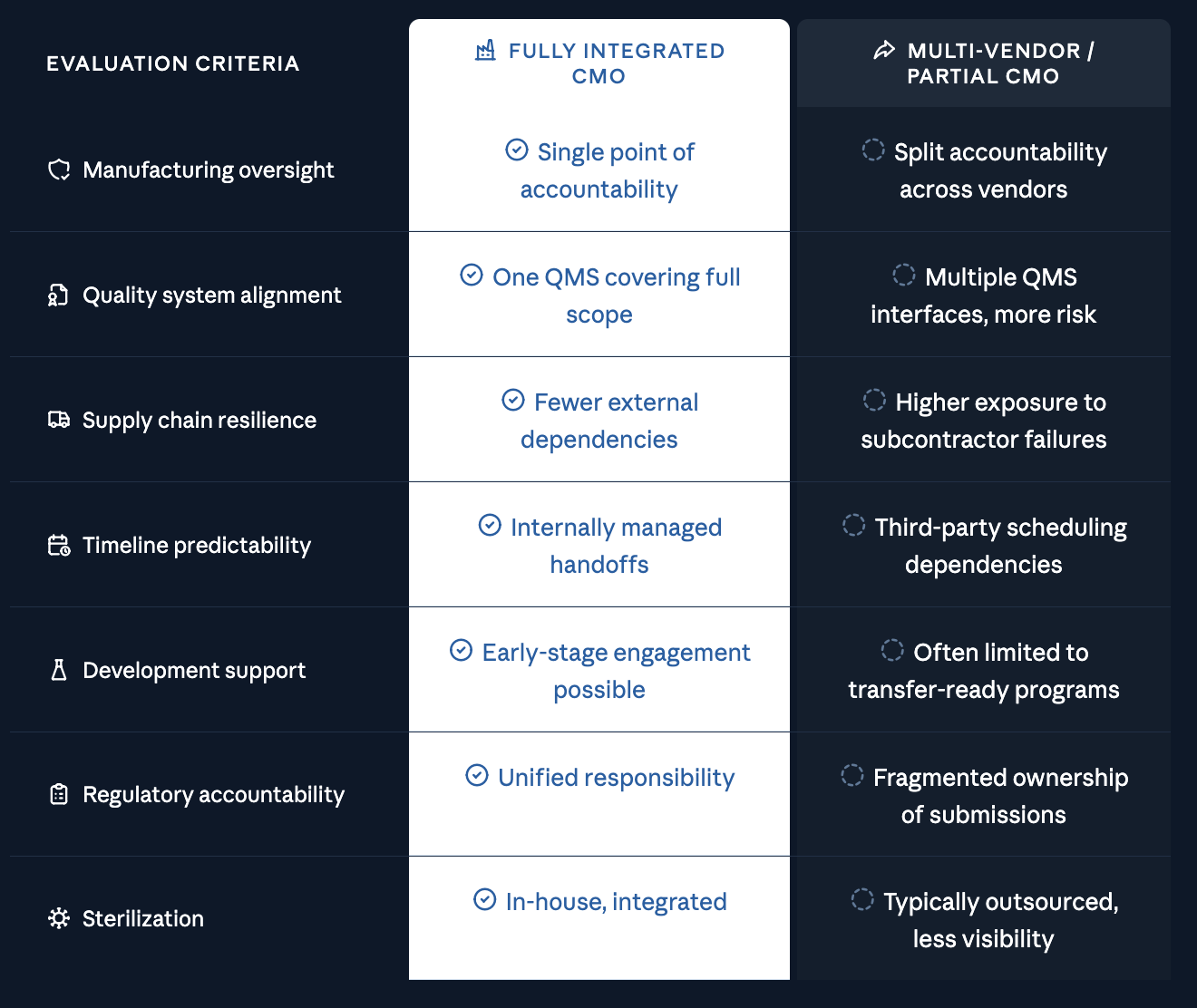
The case for vertical integration becomes clearer when you account for total program cost — not just unit price. Fragmented CMO arrangements routinely produce hidden costs in project management overhead, quality incident management, logistics complexity, and delayed timelines.
Why PiSA USA?
If you've worked through the criteria above, you have a clear picture of what a strong CMO partner looks like. Here is how PiSA USA and Centerpiece measure up.
Fully vertically integrated. From injection molding, extrusion, and assembly through clean room packaging and in-house ETO sterilization, PiSA USA manages the complete device manufacturing lifecycle under one operational umbrella. Over 200 injection molding machines, 20 extrusion lines, and three ethylene oxide sterilization facilities give customers a single, accountable supply chain.
Built for scale. Backed by Grupo PiSA's 80+ year history and 4,750,000 sq. ft. of manufacturing and distribution operations, PiSA USA has the infrastructure to support programs from development through high-volume commercial production. This isn't a startup. It's one of the most established contract manufacturing organizations in the Western Hemisphere.
Nearshore, with the advantages that come with it. Guadalajara and Tijuana offer world-class manufacturing infrastructure at competitive cost structures — with the logistics, proximity, and supply chain resilience that Asia-Pacific sourcing cannot match. Tijuana is the largest medical device manufacturing hub in North America.
Pharmaceutical + medical device expertise in one place. PiSA USA is one of the only CMOs capable of manufacturing complex pharmaceuticals and medical devices under the same quality system — making it the right partner for combination devices and pharmaceutical-adjacent programs.
A development partner from day one. PiSA USA's Manufacturing Incubation program engages OEMs at the earliest stages of development — supporting materials selection, DFM, process development, and sterilization compatibility — so you reach commercial manufacturing faster, with fewer surprises.
Ready to Evaluate PiSA USA for Your Program?
Whether you're early in development or looking to transfer an established program, our team is ready to walk through your requirements and show you exactly what PiSA USA can support.
